
Rice County Bench Warrants Explained
A bench warrant is the court's own tool against someone who already had a case and skipped a requirement in it. Rice County judges issue them for three common reasons. A missed hearing comes first. Then come unpaid obligations the judge ordered and unfinished conditions such as a program. Probation matters run a separate track. Under Minnesota Rule of Criminal Procedure 6, a violation of release conditions can bring a summons, a warrant, or a detention decision. So a bench warrant from a missed hearing and one from an alleged probation violation get handled differently. That difference shapes every next step in Rice County.
The Bench Warrant Label Rice County Uses
Rice County's own warrant export names its labels. Entries read Bench Warrant-fail to appear at a hearing. Shorter entries read Bench Warrant. A separate label reads Violation or Probation Warrant, which tells you which part of the system produced the entry. One label you will not see is capias. Minnesota and Rice County materials use bench warrant and failure to appear instead. Search for capias in this county and the local record language will not match.
Note: Copy the exact label from the record before you call, because the wording tells court staff which file to open.
How Rice County Bench Warrants Are Issued
No prosecutor applies for a typical bench warrant. No affidavit is needed either. The judge issues it from the bench in the case already open, and what it authorizes is custody so the person can be brought before the court. The entry then moves into the sheriff's system. From there it can reach statewide law enforcement channels. It stays open until the person appears, the court recalls it, or the underlying matter is resolved. Minnesota allows enforcement beyond county lines, so an open Rice County order does not stop at the border.
Bench Warrants and Arrest Warrants Compared
On a list, the two instruments look alike. In court they behave differently. One protects an existing case, and the other opens a new one; the Rice County arrest warrant search covers the complaint side in more detail.
| Feature | Bench Warrant | Arrest Warrant |
|---|---|---|
| Trigger | A missed hearing or unmet condition | Probable cause of an offense |
| Who issues it | The judge on the existing case | A judge, on a complaint |
| Underlying case | One the person was already in | A new or newly charged matter |
| How it clears | Appearance, recall, or resolution | Appearance, bail or bond, or recall |
Sign-and-Release Warrants Under Minnesota Law
Minnesota treats a first missed appearance differently in some cases. Under Minn. Stat. § 629.415, a sign-and-release warrant can issue for a specified first failure to appear in certain misdemeanor and gross misdemeanor matters. That instrument does not authorize an arrest on its own. The statute page spells out exactly when the process applies.
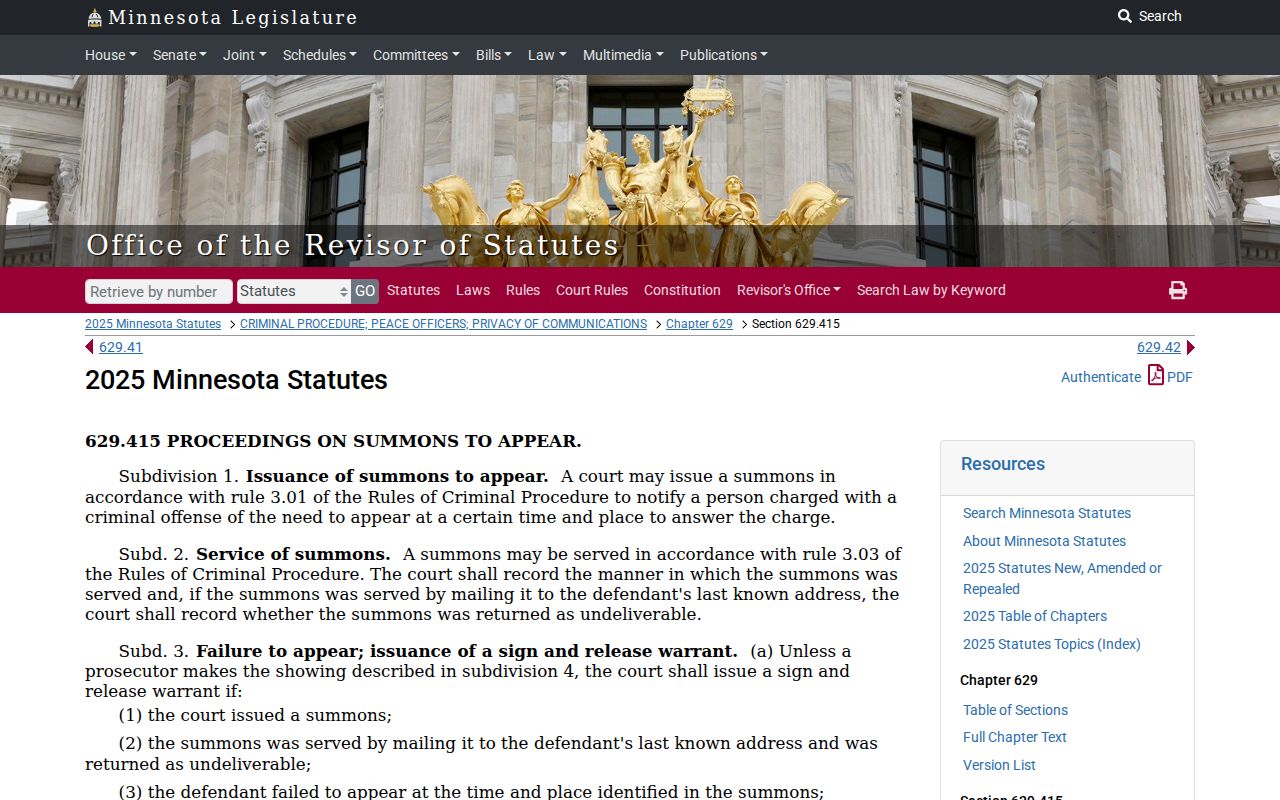
The distinction matters when you read a list entry. It matters even more when you call. Ask which instrument the court actually issued, not whether a warrant exists in general. The state statute page sets out the limited circumstances where the sign-and-release process applies. A sign-and-release order is not a dismissal. It still requires a response, and ignoring it leads back to the same Rice County court.
Resolving a Rice County Bench Warrant
No Rice County office publishes a universal recall procedure. The path runs through the issuing judge and, usually, an attorney. Confirm the instrument and the case first, then decide how to appear.
- Confirm the warrant and the court that issued it, using the case number on the record.
- Talk to an attorney about whether to appear, file a motion to recall or quash, or arrange a surrender.
- Appear on the date the court sets, or ask the court about any walk-in or remote appearance option it offers.
- Resolve the underlying obligation, whether that means appearing, paying, or resetting the case.
- Ask the court for written confirmation that the warrant was recalled, and keep it.
Caution: Do not ignore a bench warrant. It does not expire on its own, and it can surface during a traffic stop or a license transaction.
Rice County Bench Warrants Are Not Charges
A bench warrant is a procedural step in a case that already exists. The distinction matters when a record looks alarming. One related point is real, though. A failure to appear can carry its own consequences under Minn. Stat. § 609.49. That statute separates felony and misdemeanor conduct and includes a voluntary surrender provision for certain felony situations. So one missed date can produce both a bench warrant and a separate charge. An attorney can explain which applies in Rice County.
Rice County Bench Warrants: Missed Hearings
Act on the missed date before anything else. The longer a Rice County case sits, the more conditions the court can attach, and the harder it gets to explain the absence.
- Find your notice or citation and write down the case number and the hearing date you missed.
- Call Court Administration at 507-497-7134 and ask what the file shows today.
- Ask whether an appearance, a payment, or a new hearing date is required.
- Update your address with the court so future notices reach you. A missed notice does not automatically clear a warrant.
- Bring your identification and any paperwork to the courthouse, or send counsel on your behalf.
Rice County Bench Warrants and Payment
Paying a fine resolves some matters and dead-ends others. The Minnesota Court Payment Center handles eligible citations. The state warns that paying pleads guilty and waives rights. A bench warrant from a missed criminal hearing is not a payment item at all. Payment plans are similarly narrow. A monthly plan may be available for eligible fines, but a plan is not a warrant recall, and it does not touch a probation or release violation in Rice County.
Key Point: Ask the issuing court whether the matter is payable before you send money anywhere.
A payment made to the wrong office does not recall an order, and an unsolicited caller who offers to clear a warrant for payment is describing something no court does.
Finding the Court That Issued the Warrant
Rice County has one trial court path. The county sits in the Third Judicial District. All criminal, traffic, juvenile, and civil matters arising here are heard by Rice County District Court at the courthouse in Faribault. No separate municipal or justice of the peace court operates in the current structure. That single path makes the routing simple. Check whether a case is a district court matter, which it almost certainly is. Then route the recall question to that court in Rice County. A Rice County warrant lookup is how you trace which case and court hold the entry.